

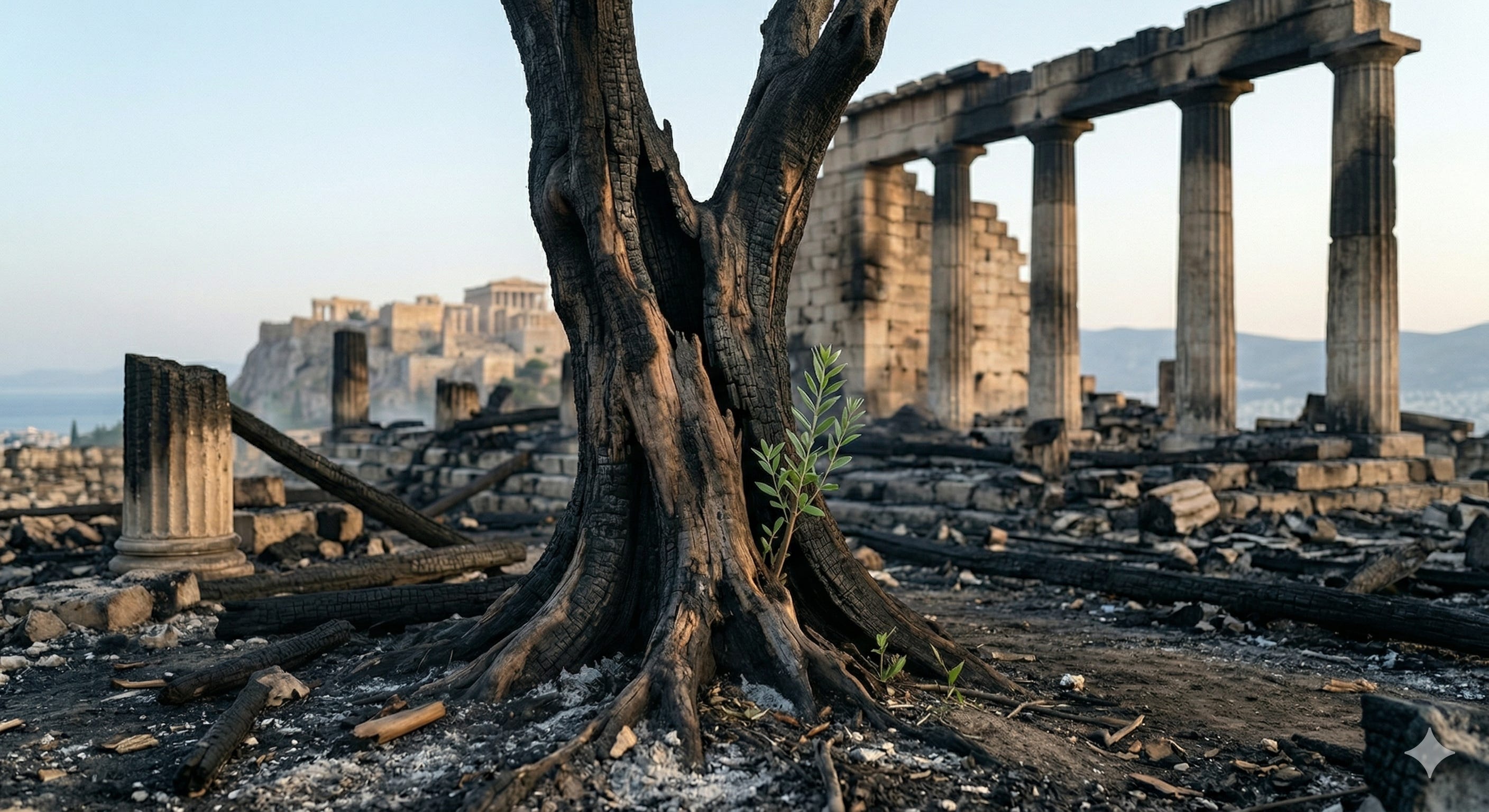
“Themistocles was regarded everywhere as by far the wisest man of all the Greeks; and the whole country rang with his fame. … Themistocles was given a crown of olive too, as the prize of wisdom and dexterity. He was likewise presented with the most beautiful chariot that could be found in Sparta.”
~ ‘The History’ (Book 8) by Herodotus (George Rawlinson transl. GB6 - p. 282)
The book ending soon after the Greeks declare, “So long as the sun keeps his present course, we will never join alliance with Xerxes”, as a response to the looming threat of another Persian invasion, was a perfect cliffhanger that makes a person want to continue to the next book. To Alexander of Macedon (the great-great-great-great-grandfather of Alexander the Great), who comes to the Athenians with the offer of alliance, this doesn’t make rational sense. Everyone knew that the Persians had already burnt Athens to the ground in the last invasion and could wreak havoc again. Alexander likely felt he was acting in good faith, trying to save a stubborn people from total annihilation. At the end of the book, one is left thinking - what will happen? Will Mardonius come charging with his large army and crush the Greeks? Will the Greek alliance be able to hold off the attack?
(I do agree that Herodotus had the whole volume of histories as one book, and later it was split into nine books. But each book was kind of self-contained, I thought. The first ended with Cyrus the Great’s rise and death, the second about the Egyptians, the third about Cambyses’ awful reign and the rise of Darius, the fourth about Darius’s conquests and so on. Book five sets up the Ionian revolt, and one does get a foreboding that things are going to take a bad turn after that.)
It was great to read about the battle of Salamis after hearing about it in many other places in the other books I read in the Great Books series (Aeschylus’ play The Persians, Aristophanes mentions it a few times) and in some contemporary references. I was reminded again to rewatch the movie 300 and its sequel. Artemisia in the book seemed to align with one in the movie played by Eva Green, as a strong naval commander, though I need to watch the movie again to jog my memory. But I think Xerxes’ depiction in the movies (as I remember) was totally off the mark.
Anyway, the main theme that I had in mind when I started writing was about Themistocles, without whom the Greeks would not have won the war. He was not the overall commander of the Greek fleet either at Artemisium, where the Greeks lost, nor at Salamis, where they won. The leader was Eurybiades, and Themistocles was one of the commanders under him, though the Athenian fleet that Themistocles was leading was the largest. Throughout the war, Themistocles’ quick thinking and cunning helped the Greeks get out of tough situations. He was the Odysseus of the Greek army.
War is incredibly unpredictable. Many times, you should not only think of how to outsmart your enemies but also how to manipulate your own army or allies, which is what Themistocles does at different stages of the war. At the start of the war, when the Greeks see the large Persian fleet and want to retreat to safety, Themistocles bribes a few commanders with the money the Euboeans gave him, and they stay and fight, though he pockets most of it. In the battle, after the Greeks suffer heavy losses, he sends messages to the Ionians and Carians to either defect or withdraw from the fight, saying that their ancestors were Greeks. His strategy: if Xerxes doesn’t discover the message, the Ionians might defect; if he does, he might distrust them and not include them in later battles. Later, before the battle at Salamis, the Peloponnesian allies wanted to retreat to the isthmus to be with their countrymen who were building a wall and to protect Sparta. Themistocles tries to convince them that Salamis has more advantages for the Greeks than the open sea. When they don’t listen, he threatens to go away with all the Athenian ships. They relent but then change their mind again. This time, Themistocles secretly sends a message to the Persian king saying that the Greeks are planning to flee. The Persians take immediate action and surround the Greeks in the night. The Greeks are left with no choice but to fight. After the Persians were defeated at Salamis, Xerxes decides to return to Persia. Themistocles initially wants the Greeks to pursue the King or go faster than him to the Hellespont and block him from crossing over to Asia, but when he sees that the majority are against it, he supports the view of letting the King go. He even sends a note to Xerxes saying that he has stopped the Greeks from blocking Xerxes’s passage back to Persia, thus ensuring some favor in case things went badly for him at Athens. Themistocles was constantly thinking strategically throughout the battle. He kept multiple options open, looked out for himself as well as the Greeks.
I wonder if every CEO needs a strategist like Themistocles to win corporate wars. In this case, Eurybiades was the overall commander (CEO) of the fleet and was engaged with the operational aspects of ‘alignment and governance’, of managing the diverse nations that had come under one umbrella to fight a common enemy, while Themistocles was the strategist who used unorthodox tactics to win the war. The Spartans rightly honor both Eurybiades and Themistocles with crowns after the war.